Christmas Eve in 2024, I was walking home after a delightful brunch with friends. The iron-grey sky promised either rain or snow flurries, so I hunched forward, cutting through the chill air like the boat’s bow, determined to avoid a downturn in the weather. Ahead of me, a man stood at the corner. From the distance of half a block, I could see his clothes were sooty and that his head rested upon his chest, as if he intended to kiss his knees.
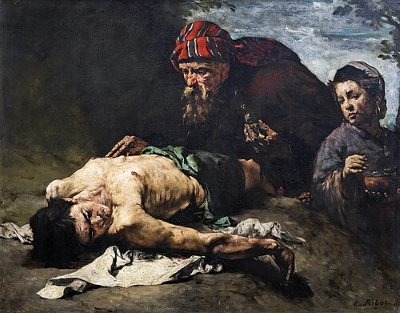
Théodule-Augustin Ribot painting courtesy of wikipedia.og
A homeless man, either drunk or suffering from drug addiction, he presented an obstacle. Should I cross the street to avoid him, or pretend he was invisible? His shabby clothes weren’t my main concern, though I’d discarded floor mops in better condition. It was his perilous state. Almost comatose, he teetered above the curb, making himself prey to any driver making a right-hand turn.
Realizing an obligation had been thrust upon me, I was angry for a moment. Who was this man that I should make him my responsibility? He’d arrived at his destiny by choice and was responsible for himself.
While I stood arguing with my thoughts, my body, to my surprise, rushed forward with outstretched hands and took hold of the stranger’s arm, narrowly preventing him from toppling into the street.
Beneath the rough fabric of his coat, his bones were apparent. If he had wanted to fend me off, I’d have had no trouble subduing him. Fortunately, he offered no resistance. Tethered to my hand, he followed me as gently as a child’s balloon.
The outdoor table of an abandoned bakery stood nearby, though no chairs were in sight. So, I hooked him across the tiled surface as neatly as if he were a Christmas ornament. After that, I called 911.
Not until the fire truck and its passenger were headed to a nearby hospital did I brace myself against the wind and hurry home. If my steps seemed lighter despite the weather, I knew why. On Christmas Eve, at least, this broken man would have a warm bed and a hot meal.
My story could have ended as a hopeful holiday tale. But the homeless man is not the issue. What stayed with me over the past year was the memory of my hesitation. I’d discovered a stranger stretched across the abyss of life and death, yet I’d paused to consider my obligation to him. No disappointment with myself could have been more profound. Even so, I am aware that while my mind had faltered, my body had acted on impulse, a recollection that has left me to wonder where our humanity lies.
Scientists have debated the existence of free will for years, and a majority have concluded it does not exist. One study does survive, however. It links free will to neural-noise. Neural-noise is what neurons generate when they communicate with each other. If too many neurons fire at the same time in one area of the brain, they create a pause—a silence which some researchers speculate is where free will resides.
Mediation teaches that silence is the portal to revelation. Could neural-noise be that portal? Could the essence of human nature exist within that silence? If so, then my experience with the homeless man suggests that as a species, we are more inclined to help rather than hurt one another. Call it harmony for the greater good, an impulse more constant than we may realize.
We see it when an individual donates a kidney to save a stranger’s life. Or, when an ambulance driver chases drones in war zones to rescue victims. Volunteers who scour a frozen hillside for a lost child are following their better angels.
Why, then, at this moment in time, have we built a society steeped in corruption and cruelty? Something has impeded our progress as human beings, for the modern atrocities taking place in Sudan and Gaza are too reminiscent of history’s horrors.
The United States once served as a beacon of justice to the world. Now, the brilliance of that beacon is dimmed by a budding autocracy. Who could have predicted that our country, of its own free will, would have elected a president convicted of 34 felonies; a man convicted of sexual aggression, and twice impeached? The first time, it was for the abuse of power. The second was for inciting an insurrection.
If we discount the impeachments as being politically driven, we can’t discount that when Trump’s friend, Ghislaine Maxwell, was imprisoned for sex trafficking, our president wished her well.
Aldous Huxley once said of human conduct, “We cannot reason ourselves out of our basic irrationality. All we can do is learn the art of being irrational in a reasonable way.” (Island, a 1962 novel.) While the statement fails to address the essence of human nature, it does suggest that though we depend upon our good impulses, we should encourage self-reflection. Otherwise, ignorance deludes us into thinking we can profit by the vacuum.
The answer to the mystery of human nature may lie in the dark space of neural-noise. My guess is that for practical reasons, mankind is basically good. We need harmony and cooperation to survive. Nonetheless, we can’t leave our evolution to chance because we are also gifted with free will. For good or ill, we must choose our path.
Each time we choose to be kind, kindness exists. Each time we wrestle with our better angels, and they win, the world becomes a better place. Our duty to ourselves and future generations is to perform as conscience beings This is not elitism. It is the means of survival.
BOYCOTT TESLA